Existing buildings · SEBC
Taking Over a Seattle Building With an Old Mezzanine: Rating, Signs and Seismic
A lease or a purchase often comes with a mezzanine someone else put up. Before stock or people go on it, find out what it was designed to carry, whether it was permitted, and what Seattle's Existing Building Code asks once you change it. Here is how those rules read, and where an engineer and our crew come in.
What Should You Find Out About an Old Mezzanine Before You Use It?
Three things: what the deck was designed to carry, whether it was permitted, and whether your use matches that design. SDCI's own permit steps start with research, including the property's permit history in the Seattle Services Portal and the City's GIS map. Seattle's open permit data shows how often this comes up. Among mezzanine records since 2019 is a 2023 tenant improvement of an existing mezzanine in a commercial building. That record is another owner's project, not ours.
- Look up the permit history for the address, and the record for the mezzanine if there is one.
- Find the posted load sign on the deck, and photograph it.
- Ask the seller or landlord for the original drawings, which show the design loads.
- Write down what you plan to store or do on the deck, and on the floor below it.
Our guide to removal and extension permits lists more papers worth gathering.
Where Does the Load Rating of an Old Seattle Mezzanine Come From?
Start with the posted sign and the original drawings; when neither exists, an engineer works the number out from the steel itself. Inside Seattle, SBC 107.1 calls for durable load signs in all warehouse and storage areas, posted by the owner, and makes it unlawful to remove or deface them. SBC 1603.1.1 has the floor live loads used in the design shown on the drawings. With no sign and no drawings, SBC 1708.1 requires an engineering assessment when there is "a reasonable doubt as to the stability or load-bearing capacity" of a structure for the expected loads.
That assessment is "either a structural analysis or an in-situ load test, or both," and the analysis uses the steel's actual properties and as-built conditions. So calculating an old deck's capacity is engineering work, not a rule of thumb. We do not issue ratings; a Washington-licensed engineer does.
When Is an Existing Mezzanine Load Tested in Seattle?
When the engineer chooses a physical test instead of, or alongside, analysis to settle a capacity question. The Seattle Existing Building Code sends any in-situ load test to SBC Section 1708 (SEBC 305.1). Under Section 1708.2, a registered design professional supervises the test, and the test simulates the loading conditions of Chapter 16. Where no material standard gives a procedure, the design professional writes one, and the code sets its basic terms:
- For parts outside the seismic force-resisting system, the test load is at least the factored design load.
- A static test load stays in place for 24 hours.
- Under the design load, deflection stays within the limits of SBC 1604.3.
- Within 24 hours of unloading, the structure recovers at least 75 percent of its maximum deflection.
A load test speaks to gravity capacity. The earthquake questions are separate, and they come next.
Does Seattle's Existing Building Code Accept an Old Mezzanine As It Stands?
Only as far as it was legal when it was built. SEBC 101.4.3 lets buildings "legally constructed and occupied" under a prior code keep their existing occupancy, "provided such occupancy is not unsafe." SEBC 302.3 lets materials that met the rules of their day stay in use unless the code official deems them unsafe. The limit is SEBC 101.4.1: "Unless approved by the code official, this code does not justify conditions in buildings or structures that do not comply with the codes in effect at the time the building or structure was built."
That sentence reaches "permitted additions, alterations, repairs, changes of occupancy and relocations" too. A deck with no permit record, or one built past the rules of its day, gets no cover from the existing-building code. Seattle's records include a 2022 permit to remove a 337 sq ft non-conforming mezzanine and its stair.
Can an Old Mezzanine Keep a Lower Load Rating Than Today's Code?
Yes, as long as your use leaves its design live load unchanged, but the area must then carry placards with the approved load. SEBC 304.1.3.1 lets existing members be checked against the live loads approved before the work. It continues: "If the approved live load is less than that required by Section 1607 of the International Building Code, the area designated for the nonconforming live load shall be posted with placards of approved design indicating the approved live load."
A heavier use changes the answer. Where the work "results in increased design live load," today's Section 1607 values apply, and Seattle's Table 1607.1 starts storage warehouses at 125 psf for light stock and 250 psf for heavy. SBC 107.3 makes it unlawful to load any floor past what the code permits. Our guide to Seattle's load sign rule covers the signs themselves.
What Happens When You Change or Add to an Old Mezzanine in Seattle?
New steel is designed to today's building code, and old members that pick up more than 5 percent more gravity load are strengthened, supplemented or replaced. SEBC 304.1.1 says: "New structural elements in alterations, including connections and anchorage, shall comply with the International Building Code." SEBC 304.1.3 then covers the old frame. Any existing gravity member whose design gravity load rises "more than 5 percent" is altered as needed to carry the load required for new structures. Existing members that carry no added load keep the loads that applied when the building was built (SEBC 304.1.2).
Seattle's edition puts these rules in Section 304, titled "Structural Requirements for All Compliance Methods," and its prescriptive, Level 2, Level 3, change of occupancy and addition chapters all point back to it. Extending a deck also follows the permit and area rules in our relocation, extension and removal page.
Does an Old Mezzanine Need a Seismic Upgrade in Seattle?
Not by default; earthquake checks come in when the planned work raises the lateral load, weakens a lateral element or creates a prohibited irregularity. Under SEBC 304.1.4, the altered structure must then meet SBC Sections 1609 and 1613, with reduced forces allowed. Section 304.4.2 sets the reduced level at 75 percent of the prescribed forces. An existing lateral element may stay as it is when its demand-capacity ratio rises "not more than 10 percent" because of the work.
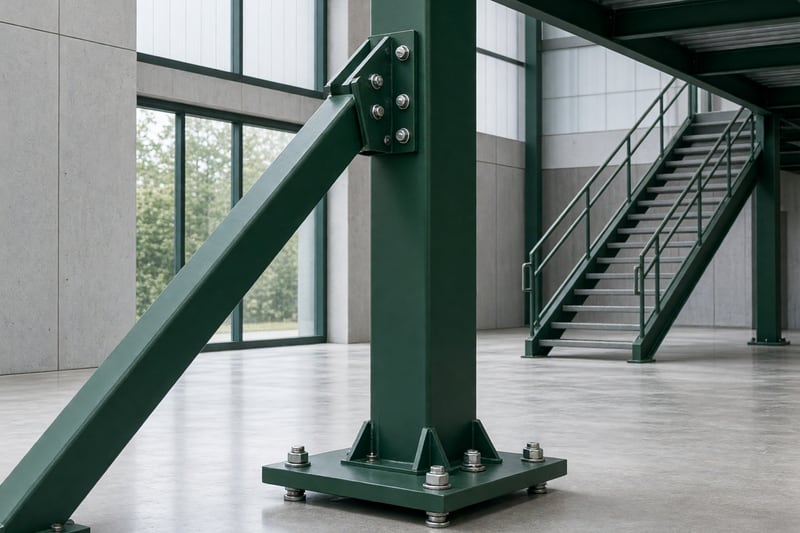
Owners may also choose to improve seismic bracing or anchorage. SEBC 304.1.7 permits that when an engineering analysis shows the altered structure is "no less conforming" for earthquake design than before. Any new part fixed to the building is designed to resist earthquake motions under SBC 1613.1. Read more on seismic mezzanine design in Seattle.
Can Taking Over a Seattle Building Bring In Wider Code Work?
Yes, in two Seattle-specific cases: a change away from storage use, and a substantial alteration. SEBC 304.2 says that where a change of occupancy is "from a Group S or Group U occupancy to any occupancy other than Group S or Group U," the structure must meet the seismic requirements for a new structure. A substantial alteration is decided by the code official. Seattle's definition includes:
- Remodeling or an addition that substantially extends the useful life of the building or a significant part of it, other than typical tenant remodeling.
- Changing a significant part of the building to a more hazardous occupancy.
- Reoccupying a building that has been substantially vacant for more than 24 months, outside Group R-3.
A substantial alteration brings in SBC Chapter 10, Sections 903 and 905 and the seismic rules of SEBC 304.4.2. A licensed structural engineer prepares a seismic evaluation report (SEBC 311.1.3). SDCI decides whether your project qualifies, so ask early. Fire and sprinkler questions are in our sprinkler and fire rating guide.
What Work Can Follow the Check on an Old Mezzanine?
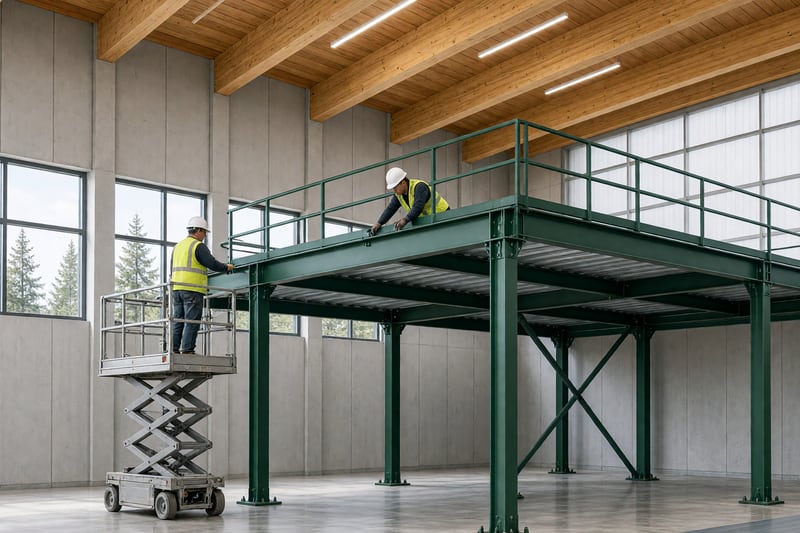
Whatever the engineer's assessment and the permit call for, and we handle the steel side of it. Strengthening, extending or taking out a deck is permit work: SBC 106.1 lists altering, enlarging, moving and removing. The $6,000 minor-work exemption leaves out "the removal, reduction, alteration, or relocation of any loadbearing support" (SBC 106.2). A Washington-licensed engineer or architect prepares the drawings (SBC 106.5.2), and our crew does the work they show:
- Add bracing or anchorage the engineer details.
- Add or upsize beams, columns or connections for a heavier use.
- Replace the deck surface with board, panel, grating or plate.
- Replace stairs and guardrail to today's Washington rules.
- Post new load signs that match the approved rating.
- Extend, move or remove the mezzanine.
Stairs and rails are on stairs, railings and gates.
Old Mezzanine Questions for Seattle, Answered
Who can tell me what an existing mezzanine in Seattle can hold?
A Washington-licensed engineer. Where there is no posted sign or drawing to go on, SBC 1708.1 calls for an engineering assessment: a structural analysis based on the actual steel and as-built conditions, an in-situ load test, or both.
Source: SBC 1708.1; SEBC 305.1
Is an old mezzanine in a Seattle building grandfathered?
Only as far as it was legal when built. Legally built and occupied buildings may keep their occupancy if it is not unsafe (SEBC 101.4.3). The code does not justify conditions that broke the codes in force at the time, unless the code official approves (SEBC 101.4.1).
Source: SEBC 101.4.1, 101.4.3
Does strengthening an old mezzanine in Seattle need a permit?
Yes. SBC 106.1 lists altering and repairing among the work that needs a building permit. The $6,000 minor-work exemption in SBC 106.2 leaves out any alteration of a loadbearing support.
Source: SBC 106.1, 106.2
Sources, read November 2026: Seattle Existing Building Code 2021, Chapter 1 (scope and compliance) · Seattle Existing Building Code 2021, Chapter 2 (definitions) · Seattle Existing Building Code 2021, Chapter 3 (compliance methods, structural rules, substantial alterations) · Seattle Existing Building Code 2021, Chapter 6 (classification of work) · Seattle Building Code 2021, Chapter 1 (permits, documents, load signs) · Seattle Building Code 2021, Chapter 16 (loads and Section 1613 earthquake design) · Seattle Building Code 2021, Chapter 17 (special inspections) · City of Seattle open data, Building Permits (mezzanine records since 2019) · SDCI, Construction Permit: Addition or Alteration