Permit guide · SDCI
Removing or Extending a Mezzanine in Seattle: The Permit Side
Taking a mezzanine out, or making it bigger, is still building work in Seattle. The city's code lists removing and enlarging among the jobs that need a permit, and its small-work exemption stops short of anything that carries load. Here is how both jobs move through SDCI.
Does Taking Out a Mezzanine in Seattle Need a Permit?
In most cases, yes. SBC 106.1 requires a building permit "prior to erecting, constructing, enlarging, altering, repairing, moving, improving, removing, changing the occupancy of, or demolishing" a building or structure. A mezzanine is a structure inside the building, and taking it out removes loadbearing steel. The same section adds: "All work shall comply with this code, even where no permit is required."
We take down, move and extend mezzanines as well as putting up new ones. See mezzanine relocation and removal in Seattle for how we plan that work. Removal changes the room too: stock that sat on the deck needs a new home, and the deck's load signs come down with it.
Does Seattle's $6,000 Exemption Cover Mezzanine Work?
Not for the structure. SBC 106.2 exempts minor repairs or alterations valued at $6,000 or less in any six-month period, with the building official setting the value. The same item then draws a firm line: "Such repairs and alterations shall not include the removal, reduction, alteration, or relocation of any loadbearing support." Columns, beams and the deck that carries people and stock all carry load.
So taking out a mezzanine, cutting one back or moving a column falls outside that exemption, whatever the dollar figure. Anything you are unsure about goes to SDCI as a question before the work starts.
What Do Seattle's Permit Records Show About Removals and Extensions?
That both happen, and both are filed. The City of Seattle's open permit data lists 62 permits applied for since January 1, 2019 that mention a mezzanine. Of those, 59 are Addition/Alteration permits. Among them are a 2022 filing to remove a 337 square foot mezzanine and its access stair, and a 2026 filing to remove a mezzanine and stairs. A 2021 industrial filing in ZIP 98108 extends an existing mezzanine across a warehouse to form a full second floor.
These are other owners' projects, not ours. We cite them only to show how SDCI files this kind of work, and we leave out names and record numbers.
Which Permit Path Does a Mezzanine Change Take Through SDCI?
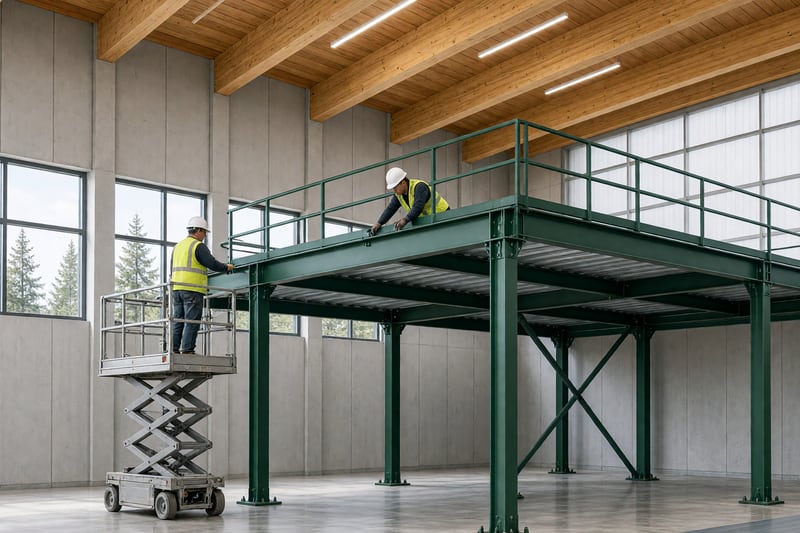
Structural changes go to plan review. SDCI's checklist for its quicker subject-to-field-inspection (STFI) permit sends a project to plan review when the work is structural. It does the same for new floor area, work over 4,500 square feet and changes to exits. In the city's mezzanine records, STFI shows up only for work on an existing mezzanine.
One 2023 commercial record in ZIP 98134 is a tenant improvement of an existing mezzanine, filed as STFI. Taking out or extending the steel is structural work, so plan for plan review on those jobs. SDCI decides the permit type for each project, and we do not assume it in advance. SDCI says it tries to finish initial review of simple applications in two to three weeks and complex ones in eight. That is the city's stated goal, not a promise from us. Our SDCI permit guide walks through each step.
How Far Can You Extend a Mezzanine in Seattle?
Until all the mezzanines in the room reach one-half of its floor area. Inside Seattle city limits, SBC 505.2.1 caps the total at "((one-third)) one-half" of the room. The room's enclosed portion does not count toward its floor area, and the deck's own area is excluded as well. Type I or II special industrial occupancies can reach two-thirds.
Past that line, the level no longer meets Section 505. Under the code's definition it is then not a mezzanine, and it no longer counts as part of the story below under Section 505.2. SDCI plan review decides how a level is classified. That is why stretching a deck toward a full second floor is a design question first. Our page on how to build a second level inside a warehouse covers it.
How Does Extending a Seattle Mezzanine Change Its Stairs and Exits?
A bigger deck can need more or different ways down. SBC 1006.2 names mezzanines among the spaces that must have the number of exits, or access to exits, that the section requires. More floor usually means more occupants. SDCI's field-inspection checklist also sends any change in the number of exits, the path of travel or the distance to exits to plan review.
Small decks show the effect clearly. SBC 1011.14 limits alternating tread devices, in Groups F, H and S, to a mezzanine of no more than 250 square feet serving five people or fewer. Extend such a deck past 250 square feet, and that device can no longer be its way out. A standard stair then goes into the design.
Who Prepares the Drawings for a Removal or Extension?
A Washington-licensed architect or structural engineer. SBC 106.5.2 has construction documents prepared by or under the direct supervision of one, with limited exceptions. That design professional seals and signs each sheet within their scope before the permit is issued. For an extension, the drawings show how the new framing ties into the old, and what the existing columns and footings must now carry.
We do not seal drawings. We coordinate the engineer, the drawings and the SDCI submittal. Then our own crew does the steel work, whether that means unbolting a frame or adding bays to one.
What Should You Gather Before a Seattle Removal or Extension?
The history of the deck you already have. SDCI's own step list for a construction permit starts with research, including the permit history in the Seattle Services Portal and the city's GIS map. The original permit and drawings tell the engineer what the frame was designed to carry, which saves guesswork on an extension. Bring what you can find:
- The original permit record and any sealed drawings for the mezzanine.
- The posted load rating on each part of the deck.
- What is stored on and under the deck today.
- Stair, gate and pallet drop positions.
- Sprinkler pipe, lights and wiring under the deck that must move or stay.
If the paperwork is gone, the engineer works from site measurements instead. It takes longer, but it gets to the same sealed set.
What Safety Rules Apply at the Deck Edge During the Work?
Washington's fall protection rules, enforced by DOSH. WAC 296-880-20005 requires protection where workers face a fall of four feet or more to a lower level. Removal and extension work often opens an edge that used to be guarded. When a guardrail must come off for a task, the rule says the area "must be constantly attended by an employee until the guardrail is replaced."
That attendant's only duty is to warn people entering the area, and the attendant wears a personal fall arrest or restraint system. See mezzanine stairs, railings and gates for a finished deck, and our guide to WAC fall protection at the edge.
What Happens After a Mezzanine Comes Out or Grows?
Inspections, and new load signs where storage area changes. SBC 108 makes permitted work subject to inspection, with a final inspection when the work is done. Inside Seattle, SBC 107.1 requires durable load signs in all warehouse and storage areas, so a larger storage deck needs signs that match its design. Where a certificate of occupancy is required, SBC 107.2 holds it until the signs are installed.
A frame taken down for reuse becomes a new install wherever it goes next. If it goes up again in Seattle, SBC 106.1 covers erecting it, so it needs a permit there too. Outside Seattle, the code of the city or county that receives it applies, and we check that edition the same way we would for new steel.
Seattle Mezzanine Removal Questions, Answered
Do I need a permit to take out a mezzanine in Seattle?
In most cases, yes. Removing and demolishing are both on SBC 106.1's list of work that calls for a building permit. The $6,000 minor-work exemption also leaves out the removal of any loadbearing support.
Source: SBC 106.1 and 106.2
Can I extend my mezzanine in Seattle without a new permit?
Plan on a permit. Extending a mezzanine enlarges a structure, which SBC 106.1 lists, and it is structural work that SDCI's STFI checklist sends to plan review. The bigger deck must still stay within one-half of the room inside Seattle city limits.
Source: SBC 106.1; SDCI STFI checklist; SBC 505.2.1
Can a mezzanine taken out in Seattle go up again somewhere else?
Only as a new install at the new site, designed by an engineer for that building and permitted there. Inside Seattle, SBC 106.1 requires a permit before erecting or moving a structure.
Source: SBC 106.1
Sources, read November 2026: Seattle Building Code 2021, Chapter 1 (permits, documents, load signs) · City of Seattle open data, Building Permits (mezzanine records since 2019) · SDCI, Construction Permit: Addition or Alteration · SDCI, Multifamily and Commercial STFI Checklist · SDCI, Construction Permit: Subject-to-Field-Inspection · Seattle Building Code 2021, Section 505 · Seattle Building Code 2021, Chapter 2 (definitions) · Seattle Building Code 2021, Chapter 10 (means of egress) · Chapter 296-880 WAC, Unified safety standards for fall protection