Safety guide · WAC 296-880
Washington's Fall Protection Rule on a Seattle Mezzanine Edge: WAC 296-880 Next to Federal OSHA
Washington writes its own workplace safety rules, and the Division of Occupational Safety and Health (DOSH) at L&I enforces them. At a mezzanine edge, most of those rules sit in chapter 296-880 WAC. This guide sets each Washington rule beside the federal 29 CFR 1910 text, so you can see where they match and where they part ways.
Who Enforces Fall Protection on a Seattle Mezzanine?
DOSH does, for most private workplaces in Seattle. OSHA's page on the state says: "The Washington State Plan is administered by the Department of Labor and Industries, Division of Occupational Safety and Health (DOSH)." The plan covers private sector workplaces, with listed exceptions, plus state and local government workers. It "does not cover federal government workers, including USPS." DOSH has adopted most federal standards by reference. Walking-working surfaces and materials handling are among the areas where Washington writes its own. Our Seattle mezzanine stairs, railings and gates page shows how we build to those rules.
At What Height Does Washington Require Fall Protection on a Mezzanine?
At 4 feet, the same height as the federal rule. WAC 296-880-20005 has employers protect workers "exposed to fall hazards of four feet or more to the ground or lower level." Federal 1910.28(b)(1)(i) covers an unprotected side or edge "that is 4 feet (1.2 m) or more above a lower level." So nearly every working deck edge is in scope under both. The difference lies in how each fills in the detail. Washington puts its fall protection, guardrail and toeboard rules in one chapter, 296-880 WAC. Its quick reference guide opens with "General fall protection for all industries."
How Do WAC 296-880 and Federal OSHA Compare at a Mezzanine Edge?
They agree on the trigger height and the guardrail height range, and differ on the detail. Washington lists rail member sizes. It asks for an attendant when a rail comes off. It also requires a written work plan at 10 feet unless guardrails remove the hazard. The federal text we read uses performance criteria for rails. It deals with removed rails at hoist areas through sections, chains or gates. The table sets the two side by side, using only the rule text.
| Topic | Washington (WAC) | Federal (29 CFR 1910) |
|---|---|---|
| Who enforces | L&I DOSH, under the State Plan | Federal OSHA; federal workplaces in Washington stay federal |
| Where the rules live | Chapter 296-24 WAC for surfaces; chapter 296-880 WAC for fall protection, guardrails and toeboards | Subpart D, 1910.21 to 1910.30 |
| Trigger height at an edge | 4 feet (296-880-20005) | 4 feet (1910.28(b)(1)(i)) |
| Top rail height | 39 to 45 inches (296-880-40005) | 42 in, give or take 3 in, per 1910.29(b)(1) |
| Rail members | Minimum pipe and angle sizes; posts no more than 8 feet apart | Performance criteria; no member sizes in the text read |
| Removing a rail to load | A worker stays at the opening, with arrest or restraint | Hoist areas: removable section, chains or gates; arrest system if leaning through |
| Ladderway and platform openings | Swinging gate, or an offset passage | A gate that closes on its own and moves clear of the hole, or an offset |
| Written plan | Work plan at 10 feet or more, unless guardrails remove the hazard | In the 1910.28 text read, only for residential roofs where usual systems are not workable |
| New stair rails | 42 inches, separate from the handrail (on or after October 1, 2020) | 42 inches (on or after January 17, 2017); top rail may double as handrail at 36 to 38 inches |
What Does a Washington Guardrail Have to Meet on a Seattle Mezzanine?
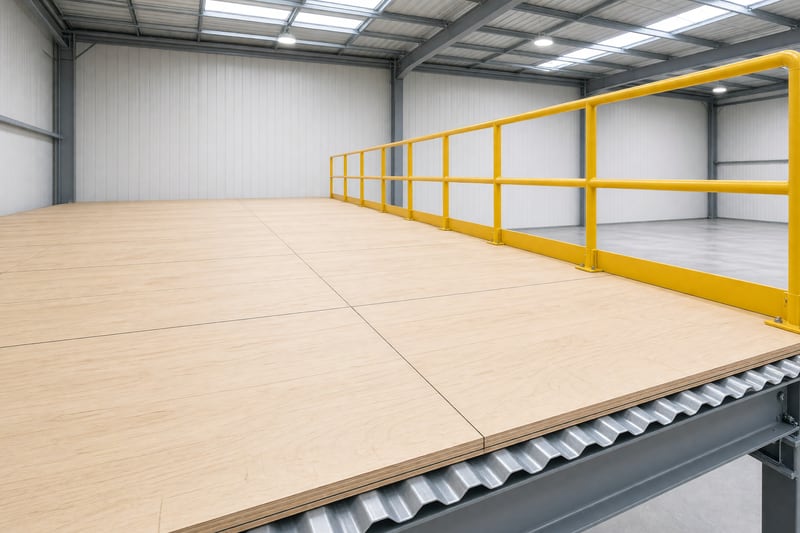
A top rail 39 to 45 inches high, a mid rail halfway down, and members of listed minimum sizes. WAC 296-880-40005 gives the detail. "The intermediate rail must be halfway between the top rail and the floor." Under federal 1910.29(b)(1), the top rail sits "42 inches (107 cm), plus or minus 3 inches (8 cm), above the walking-working surface." That is the same range, written another way. The real gap is the member list. Washington names sizes, while the federal text we read sets performance tests.
- Pipe rails: "at least one and one-half inches nominal OD diameter with posts spaced not more than eight feet on centers."
- Steel shapes: "two-inch by two-inch by three-eighths inch angles or other metal shapes of equivalent bending strength," with posts no more than 8 feet apart.
- Strength: "capable of withstanding a load of at least 200 pounds applied within two inches of the top edge, in any outward or downward direction."
- Deflection: under that load, the top edge stays at 39 inches or higher.
- Heavy use: rails stressed by workers "trucking or handling materials" get heavier stock, closer posts or bracing.
That last line matters on a busy pick deck. Where carts and pallet jacks run along an edge, we plan stiffer rails with the engineer.
When Does a Seattle Mezzanine Edge Need a Toeboard?
Wherever people can walk below, or machinery or equipment sits under the edge. WAC 296-880-20005(1)(a) asks for a standard guardrail on all open sides, except at the entrance to a ramp, stairway or ladder. It adds a toeboard wherever "Beneath the open sides, persons can pass, there is moving machinery, or there is equipment with which falling materials could create a hazard." Under a warehouse deck, that covers most edges. A standard toeboard is "a minimum of three and one-half inches in vertical height," with openings no larger than 1 inch. It sits no more than a quarter inch above the deck. Where stock is piled above the toeboard, panels or screening must run up to the mid rail or top rail.
What Happens When a Rail Comes Off to Load a Seattle Mezzanine?
Washington requires a person to stand guard at the gap. WAC 296-880-20005(1)(a)(iii) says the area "must be constantly attended by an employee until the guardrail is replaced." That person's only task is to warn others of the fall hazard. They must wear a personal fall arrest or fall restraint system. The federal text handles loading at hoist areas instead. Under 1910.29(b)(10), a removable top rail and mid rail section closes the opening between lifts, or chains or gates do. A worker who leans through to hoist uses personal fall arrest, per 1910.28(b)(2)(ii).
That is why we favor pallet stations that never leave the edge open. A two-gate station keeps one gate shut at all times, so no rail has to come off. It is our design choice, not a code requirement. Our mezzanine options page shows the gate types.
How Are Ladderway and Platform Openings Guarded in Washington?
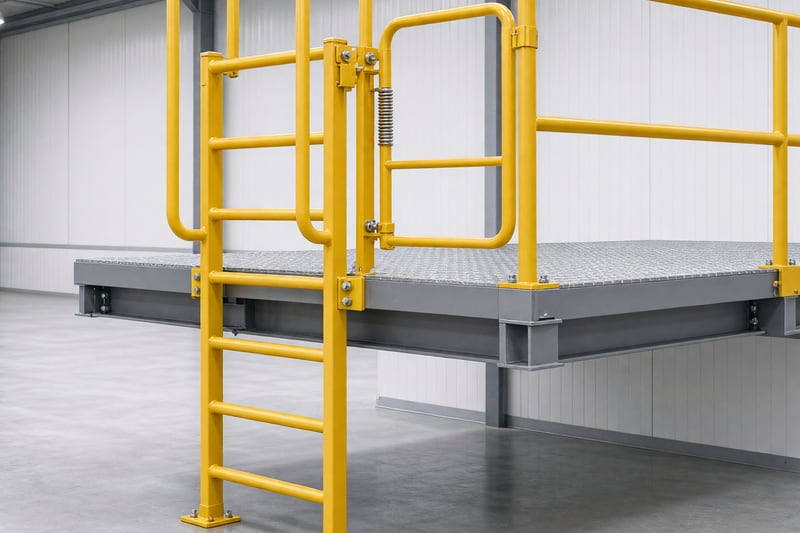
With guardrail and toeboards on the exposed sides, plus a swinging gate or an offset at the way in. WAC 296-880-20005(3)(d) asks for the passage to be "provided with a swinging gate or so offset that a person cannot walk directly into the hole." The federal 1910.29(b)(13)(i) describes a "self-closing gate that slides or swings away from the hole," with a top rail and mid rail, or an offset. The two are worded differently, and we do not rank one above the other. We fit the gate or offset the drawings call for and check it against the WAC wording.
Does Washington Require a Written Plan at a Mezzanine Edge?
Only where a fall would be 10 feet or more and guardrails do not remove the hazard. WAC 296-880-10020 calls for a written fall protection work plan wherever "fall hazards of ten feet or more exist." Its note adds: "A fall protection work plan is not required where the use of a guardrail system eliminates the fall hazard." In the federal 1910.28 text we read, a written plan appears only for residential roofs where usual systems are not workable. So a fully guarded Seattle deck edge usually needs no written plan. Our guide to fall protection work plans at ten feet covers the spots where one is still needed.
Does the Seattle Building Code Add Its Own Guard Rules?
Yes, and they run on a separate track. The Seattle Building Code has its own guard rules, and SDCI checks them in plan review. They protect anyone using the building. The WAC rules in this guide protect employees, and DOSH enforces them. We keep the two sets apart on the drawings and build each rail to pass both. Our Seattle permits and code guide lists the building code side.
- Map every open side, stair head and ladder opening on the layout.
- Choose the rail: pipe or steel shapes, posts at 8 feet or closer, heavier where carts run.
- Add toeboards wherever anyone can pass below.
- Fit gates at pallet stations and ladder openings.
- Check the finished edge against the WAC wording before handover.
Washington Fall Protection Questions, Answered
Does federal OSHA or DOSH inspect a Seattle warehouse mezzanine?
DOSH, for most private employers. Washington's State Plan is run by L&I's Division of Occupational Safety and Health and covers private workplaces and state and local government workers. Federal government workers, including USPS, stay with federal OSHA.
Source: OSHA, Washington State Plan
What guardrail height does Washington require on a Seattle mezzanine?
A top rail 39 to 45 inches high under WAC 296-880-40005, with a mid rail halfway between it and the floor. The federal figure of 42 inches, plus or minus 3, covers the same range.
Source: WAC 296-880-40005; 29 CFR 1910.29(b)(1)
Can a crew take a guardrail off to load a Seattle mezzanine?
Only with an attendant. WAC 296-880-20005(1)(a)(iii) keeps a worker at the opening until the rail is back. That worker's sole duty is to warn others, and they wear fall arrest or restraint.
Source: WAC 296-880-20005(1)(a)(iii)
Sources, read November 2026: OSHA, Washington State Plan · Chapter 296-880 WAC, Unified safety standards for fall protection · WAC 296-24-73502 · WAC 296-24-74015 · OSHA 29 CFR 1910.28 · OSHA 29 CFR 1910.29