Fire code guide · Seattle
High-Piled Storage on a Seattle Mezzanine: The Fire Department Permit and Rack Rules
Tall stacks of stock bring the Seattle Fire Department into a mezzanine project. Its permit starts once high-piled storage covers more than 500 square feet, and it renews every year. The racks answer to their own section of the building code.
Does High-Piled Storage on a Seattle Mezzanine Need a Fire Permit?
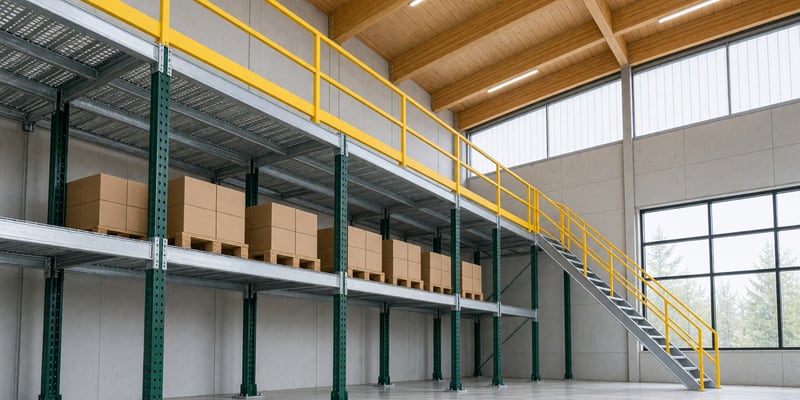
Yes, once the high-piled storage area passes 500 square feet. The Seattle Fire Department requires a permit "to use any building or portion of a building as a high-piled storage area exceeding 500 square feet." Those words reach any portion of a building, so ask about stock on the deck and stock under it. This permit is about how the space is used. It sits beside the building permit for the steel, not inside it.
We supply and install warehouse mezzanines in Seattle and rack-supported mezzanines. Stack heights come up on the first site visit, because they shape the deck, the racks and the permits.
What Counts as High-Piled Storage in Seattle?
Storage taller than 12 feet, or taller than 6 feet for certain high-hazard goods. The Fire Department's Client Assistance Memo 5983 draws both lines. It describes storage "where the commodity exceeds 12 feet in height." For some high-hazard commodities, the line drops to goods "stacked or stored more than six feet above the floor." The memo is written to the 2021 Seattle Fire Code, Chapter 32.
| Question | What the memo says |
|---|---|
| Height that makes storage high-piled | The commodity is over 12 feet tall |
| Height for certain high-hazard commodities | Stacked or stored more than 6 feet above the floor |
| Area that needs a permit | More than 500 square feet of high-piled storage |
| How long a permit lasts | One year: Fire Department permits are renewed annually |
| Code the memo is written to | 2021 Seattle Fire Code, Chapter 32 |
Once storage is high-piled, the 500 square foot trigger is about area alone: one long run of tall racking can pass it. Which goods count as high-hazard is the Fire Department's call. Bring your commodity list when you ask, and ask before stack heights are set.
How Are Stack Heights Judged When Storage Sits on Two Levels?
Ask the Fire Department, with a drawing in hand. The memo's lines measure the commodity itself: over 12 feet, or over 6 feet for some goods. A mezzanine splits one tall room into two levels, each with its own stacks. How the department applies its lines to that layout is its decision, not ours. A clear drawing gets you a clear answer sooner. Show it:
- The stack or rack height on the floor below the deck.
- The stack or shelf height on the deck itself.
- The square footage of each storage zone, on both levels.
- The commodities, with any high-hazard goods flagged.
- Aisles, stairs and the pallet drop points.
Is a Seattle Mezzanine Part of the Fire Area?
Yes. SBC 505.2 says "The area of the mezzanine shall be included in determining the fire area." A compliant deck stays out of the story count and the building area under that same section. For fire areas, though, its square footage is added in. Equipment platforms differ: Seattle's rewritten SBC 505.3 keeps them out of the fire area.
Sprinkler layout around a storage deck belongs to your fire protection designer and to plan review. This guide does not cover sprinkler standards. We share the framing plan early, so pipe runs and joists can be lined up on paper.
What Does SBC 505.3.2 Say About Sprinklers on Equipment Platforms?
It calls for sprinkler heads over and under the platform when the building itself has to be sprinklered and the referenced standards ask for it. The text reads that such platforms "shall be fully protected by sprinklers above and below the platform, where required by the standards referenced in Section 903.3." That line is about equipment platforms, not storage decks. The code defines an equipment platform as "An unoccupied, elevated platform used exclusively for mechanical systems or industrial process equipment." A deck that holds stock is a mezzanine under Section 505.2 instead. Our page on industrial work platforms in Seattle covers raised decks for equipment.
Which Rules Cover the Racks Under or on a Seattle Mezzanine?
SBC 2209.1 covers steel storage racks, and the fire code asks that racks stay sound. Under SBC 2209.1, rack design, testing and use follow RMI ANSI/MH 16.1. Where ASCE 7 requires it, their seismic design follows ASCE 7 Section 15.5.3. Seattle Fire Code 3205.2 adds a plain line: "The structural integrity of racks shall be maintained." A rack-supported deck starts from those rack rules, and your engineer sets the seismic design for your site.
Taller racks add steps in Seattle:
- SDCI asks for rack shop drawings from 6 feet tall, sealed by a civil engineer up to 8 feet and a structural engineer above that.
- Racks 8 feet or taller to the top load level, in Seismic Design Category D, E or F, get periodic special inspection (SBC 1705.13.7).
- Those same racks need a certificate of compliance to the owner once the install is done (SBC 2209.3).
Keep the rack shop drawings and any certificate of compliance with your building records, next to the load rating for each level. Our guide to pallet rack seismic requirements in Seattle goes further into those steps.
What Design Load Does a Seattle Storage Deck Need?
125 psf is the starting figure for light storage, and heavier stock calls for more. SBC Table 1607.1 gives storage warehouses two rows, a light one at 125 psf and a heavy one at 250 psf. It adds that they "shall be designed for heavier loads if required for anticipated storage." SBC 1607.3 ties every design load to "the maximum loads expected by the intended use or occupancy." So your stock list sets the rating, and the minimum in the table is only the floor of the range.
| Use on or under the deck | Minimum uniform live load |
|---|---|
| Storage warehouse, light | 125 psf |
| Storage warehouse, heavy | 250 psf, or more for heavier stock |
| Wholesale stores, all floors | 125 psf |
| Manufacturing, light | 125 psf |
| Manufacturing, heavy | 250 psf |
High stacks and heavy pallets often travel together in Seattle warehouses, from SODO to the Duwamish valley floor. If the fire permit question is on the table, the load question usually is too, so we settle both from the same stock list.
How Does the Fire Permit Fit With the SDCI Building Permit?
They are two permits from two departments, for two different things. The building permit covers the mezzanine itself. A new deck is structural work, and SDCI's field-inspection checklist sends structural work to plan review. The Fire Department permit covers using the space for high-piled storage. It renews every year, so it stays with the operation long after the steel is signed off.
Seattle adds one more step for storage floors. SBC 107.1 calls for durable load signs in all warehouse and storage areas. Where a certificate of occupancy is required, SBC 107.2 holds it until those signs are up. See Seattle's load sign rule.
What Should You Have Ready Before Stock Goes on the Deck?
A clear picture of what you store, how high it goes and where it sits. That one set of facts drives the deck's design load, the rack plan and the Fire Department's questions. Pull it together during layout, while lines on a drawing are still cheap to move. Our checklist:
- The commodity list, with high-hazard goods marked.
- Planned stack and rack heights on each level.
- The floor area of each storage zone.
- Rack drawings, if racks carry the deck or stand on it.
- The design load for each area, so the posted signs match the drawings.
You order the deck, stair and rails from us, and our own installers set them in place. A Washington-licensed engineer seals the drawings, and we coordinate them with SDCI. Later, the yearly permit renewal is a good moment to check that the storage still matches what the permit describes.
Seattle High-Piled Storage Questions, Answered
How much high-piled storage needs a fire permit in Seattle?
More than 500 square feet. The Seattle Fire Department requires a permit to use any building, or any portion of one, as a high-piled storage area over 500 square feet. Its memo treats storage over 12 feet as high-piled, or over 6 feet for certain high-hazard goods.
Source: SFD Client Assistance Memo 5983
Does a Seattle high-piled storage permit need renewing?
Yes, every year. The Fire Department's memo says its permits must be renewed annually. Plan for it as part of running the storage area, apart from the one-time SDCI building permit for the deck.
Source: SFD Client Assistance Memo 5983
Do racks on a Seattle mezzanine need seismic design?
Where ASCE 7 requires it, yes. SBC 2209.1 sends steel storage rack design to RMI ANSI/MH 16.1 and their seismic design to ASCE 7 Section 15.5.3. Your engineer sets the seismic design for your site.
Source: SBC 2209.1
Sources, read November 2026: Seattle Fire Department, Client Assistance Memo 5983, High-Piled Storage · Seattle Fire Code 2021, Chapter 32 · Seattle Building Code 2021, Section 505 · Seattle Building Code 2021, Chapter 2 (definitions) · Seattle Building Code 2021, Chapter 22 (steel and storage racks) · Seattle Building Code 2021, Chapter 17 (special inspections) · SDCI, Post-Permit Submittals: Shop Drawing Requirements · SDCI, Multifamily and Commercial STFI Checklist · Seattle Building Code 2021, Chapter 1 (permits, documents, load signs) · Seattle Building Code 2021, Chapter 16 (loads and Section 1613 earthquake design)