Buyer's guide · Washington L&I
Checking a Washington Mezzanine Contractor: L&I Registration, Bond and Insurance
Before anyone sets steel in your Seattle building, check them with the state. Washington makes construction contractors register with the Department of Labor and Industries (L&I) and carry a bond and insurance. Here is what that covers and how to check it yourself.
Does a Mezzanine Contractor in Washington Have to Register With L&I?
Yes. L&I puts it plainly: "Washington State requires all construction contractors to register with L&I." The same page says state law also requires those contractors to carry a bond and insurance to protect the public. Putting up a steel mezzanine is construction work, so the rule reaches every installer you talk to, from a two-person crew to a large firm.
Our own crew is licensed and insured, and the about page sets out how a Seattle job runs with us. Ask us for our registration when you request a quote, and check it the same way you would check anyone else.
What Does Washington Require Before a Contractor Can Register?
Four steps, as L&I lists them on its registration page. The bond and the insurance are part of getting registered, not extras added later. That is why a current registration tells you something about all three at once: the business, the bond and the policy. In L&I's own order:
- Register the business with the Department of Revenue.
- "Get a surety bond or an assignment of savings."
- "Purchase a general liability insurance policy."
- "Complete your Application for Contractor Registration."
Once those are in place, L&I says, "contractors can bid, advertise, and perform construction work." Registration is the permission to offer the work at all, so the check belongs at the quote stage, not after a contract is signed.
What Is the Difference Between a General and a Specialty Contractor in Washington?
Scope. L&I says "General contractors can perform most types of construction work." It also says "Specialty contractors can only perform work in the specialty they are registered in." So a specialty registration reaches only as far as the specialty it lists. A mezzanine job touches steel framing, decking, stairs, guardrail and anchors to the slab, so the fit matters.
We do not name a registration class for mezzanine work in this guide. Ask each installer which kind it holds and what that registration lists, then confirm the answer with L&I. Sometimes a job is split, for example one firm for the steel and another for wiring under the deck. Then each firm's registration should fit its own part.
How Do You Look Up a Contractor's Registration in Washington?
On L&I's website, before you sign anything. L&I's advice for people hiring a contractor starts with two checks. First, "Verify the contractor has an active license." Second, make sure the contractor carries a bond and insurance for damages that may occur. Do both for every installer you are comparing, and keep a note of what you saw and when.
When you look, match these details against the quote in your hand:
- The business name on the registration matches the name on the quote and the contract.
- The registration shows as active on the day you check.
- The registration type, general or specialty, fits the work in the quote.
- The bond and insurance L&I asks you to confirm are in place.
Look it up yourself rather than relying on a number printed on a flyer, a truck door or a web page. This site prints no registration numbers, by design. If months pass between the quote and the start date, check the status again before the crew arrives.
What Happens to Contractors Who Work Without Registering?
They face penalties. L&I warns that "Working without registering as a contractor in Washington carries substantial penalties and fines." For you as the owner, the practical point is simpler. An unregistered crew has not shown L&I the bond and the liability policy that registration requires. That leaves you relying on promises instead of records, which is the gap the state's system is there to close. A registration takes minutes to check, and it is worth doing for every name on every quote.
Does an Installer From Out of State Need a Washington Registration?
L&I's wording names all construction contractors, and it does not single out where a company is based. Some installers who quote Seattle jobs run their work from other states. If one of them quotes your project, ask how it is registered in Washington. Then look that registration up on L&I's site, exactly as you would for a local firm. Ask L&I directly about any case that is not clear.
The same goes for subcontracted crews. If the company on the quote hands the install to another crew, ask for that crew's registration too.
What Does a Washington Registration Not Tell You?
Whether the deck is designed right for your room. Registration shows that the business, the bond and the liability policy are on file with the state. It does not review drawings, size a beam or check the code. In Seattle those jobs belong to the sealed drawings and to SDCI, whose field-inspection checklist sends structural work to plan review.
So treat the L&I check as the first filter, not the last. A registered installer still needs a sealed design, a permit and inspections behind the quote.
Who Seals the Drawings, and Who Holds the Registration?
Two different people, with two different credentials. In Seattle, SBC 106.5.2 has construction documents prepared by or under an architect or structural engineer "licensed to practice under the laws of the State of Washington," with narrow exceptions. That design professional seals and signs each sheet within their scope before the permit is issued. The contractor's L&I registration covers doing the work, not designing it.
SDCI's Tip 100 says the same in plainer words: commercial projects use Washington state licensed designers, such as architects and structural engineers, to prepare plan documents. We do not seal drawings ourselves. A Washington-licensed engineer or architect seals them, and we coordinate the set with SDCI.
Which Washington Safety Rules Cover an Install Crew?
Washington's own rules, enforced by L&I's Division of Occupational Safety and Health (DOSH). Washington runs an OSHA-approved State Plan, and it writes its own fall protection chapter, 296-880 WAC. For crews placing structural members, WAC 296-880-30005 sets fall protection at 10 feet. When that work happens on or from a floor, deck or roof, the 4-foot rule applies instead.
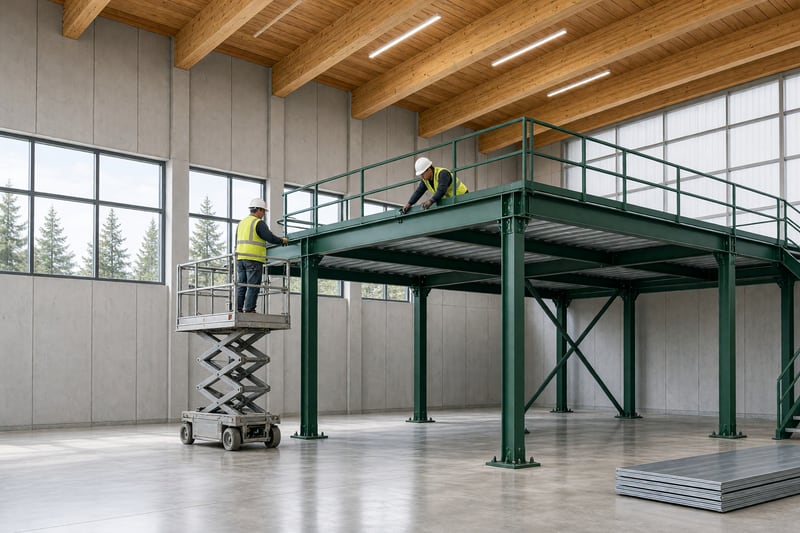
Ask any installer how its crew meets those rules on your floor, in Washington's terms. A crew that answers with the WAC sections, not only the federal ones, has likely done this work under the State Plan before. Our guide to Washington fall protection at a mezzanine edge sets out the rule.
What Should a Seattle Buyer Ask Before Signing?
Questions with answers you can check, and the answers in writing. A registration can be looked up. A bond and a liability policy can be confirmed. A sealed drawing set carries a name on every sheet. These questions turn a pile of quotes into offers you can line up side by side:
- What name is your L&I registration under, and is it general or specialty?
- Can you show the bond and insurance L&I asks buyers to confirm?
- Which Washington-licensed engineer or architect seals the drawings?
- Who prepares the SDCI submittal, and who answers plan review comments?
- How does your crew meet chapter 296-880 WAC while the frame goes up?
- Does the price include the stair, guardrail, gates and Seattle's load signs?
Our own short version: licensed and insured, with sealed drawings from a Washington-licensed engineer. One order with us covers the steel, deck, stair and rails, and our crew puts them up. Our Seattle mezzanine installers page lists every type we build out.
Seattle Contractor Check Questions, Answered
How do I check a mezzanine contractor's registration in Seattle?
Look it up on Washington L&I's website. Registration is statewide, so a Seattle job uses the same check as any job in Washington. L&I tells people hiring a contractor to verify an active license and to confirm the bond and insurance.
Source: Washington L&I, Hiring a Contractor
Does a Seattle mezzanine contractor need a bond and insurance?
Yes. L&I says state law requires construction contractors to carry a bond and insurance to protect the public. A surety bond, or an assignment of savings, and a general liability policy are both steps in registering.
Source: Washington L&I, Register as a Contractor
Can a specialty contractor install a mezzanine in Seattle?
Only within the specialty it is registered in. L&I says specialty contractors can only perform work in their registered specialty, while general contractors can perform most types of construction work. Confirm what the registration lists before you hire.
Source: Washington L&I, Register as a Contractor
Sources, read November 2026: Washington L&I, Register as a Contractor · Washington L&I, Hiring a Contractor · Seattle Building Code 2021, Chapter 1 (permits, documents, load signs) · SDCI Tip 100, Getting a Multifamily or Commercial Construction Permit · SDCI, Multifamily and Commercial STFI Checklist · OSHA, Washington State Plan · Chapter 296-880 WAC, Unified safety standards for fall protection